
Shadows in Architecture and Interiors: Light, Texture and Imperfection
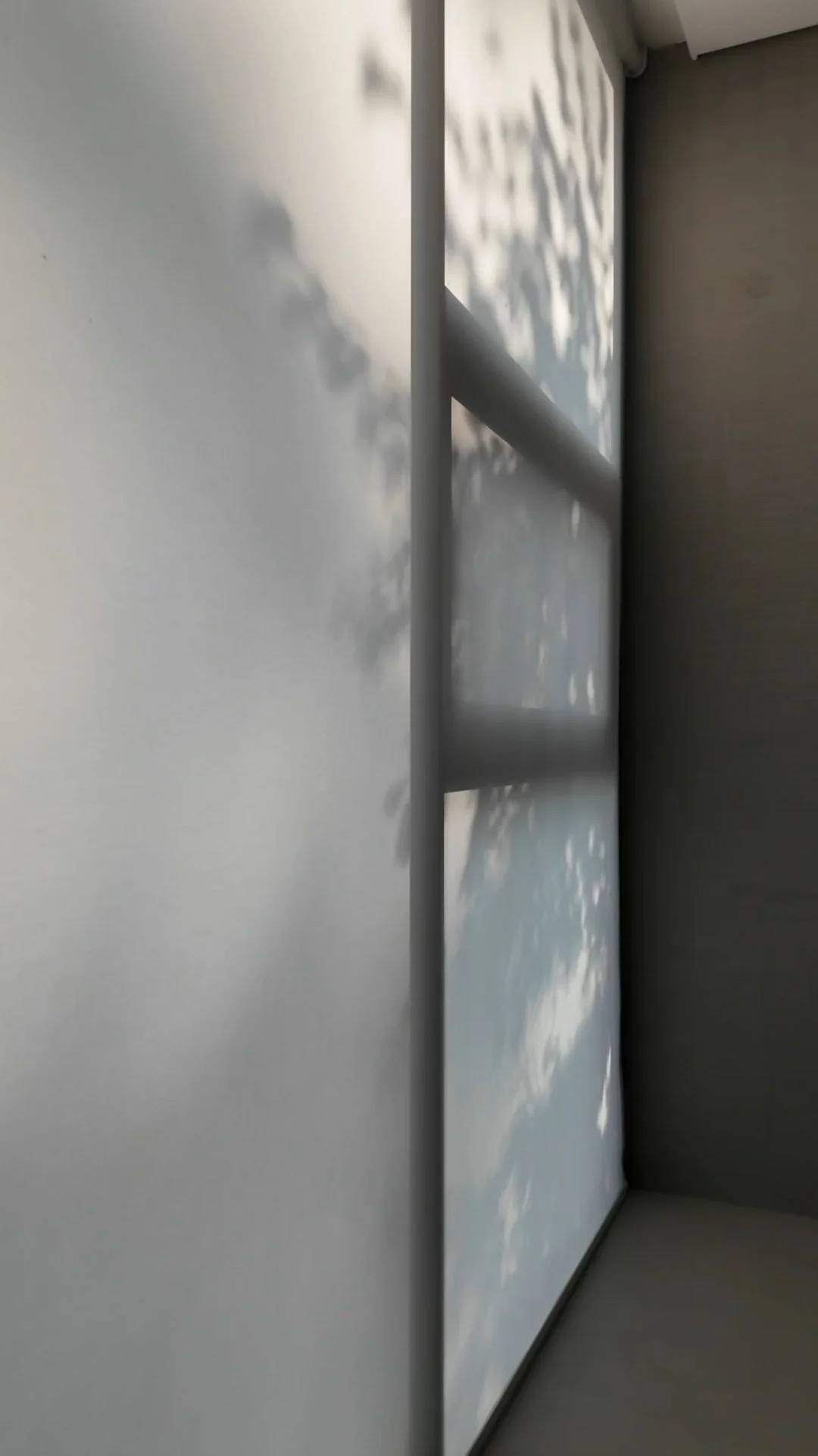
Why I am drawn to louvre shadows, subtle variations in timber and chipped stone edges—and how these details shape the feeling of a home.
Sometimes I find the shadow of an object more interesting than the object itself. Stripes from blinds stretching across the floor. The outline of a plant on a wall. A thin dark line between timber boards.
This is why I keep returning to shadows. When we discuss an interior, we usually talk about how much light it will receive and where the fixtures should go. I think another question deserves just as much attention: what are we going to leave in shadow?
What I used to misunderstand about shading louvres
I used to be quite sceptical about exterior screens and aluminium louvres fitted over windows. Looking at the gaps between the slats, I would wonder how they could possibly help with the heat. The sun could still get through.
What interested me was what happens behind them throughout the day. As the sun changes position, the pattern moves across the floor and walls. A strip of sunlight becomes a strip of shade. The light gradually reaches another part of the room. A fixed structure produces an interior that keeps changing.
Exterior shading helps limit heat gain by intercepting some solar radiation before it passes through the glass. Its effectiveness depends on the window’s orientation, the season and the geometry of the slats.
Moving shadows do not, however, guarantee that surfaces will never overheat or fade. Fading depends on cumulative light exposure; a brief period in shade does not undo earlier exposure to sunlight.
Still, I find this a fascinating architectural device. We can work with the spacing, depth and direction of the slats. We are choosing both the appearance of the facade and the pattern that will appear inside the house.
Sometimes a light is there for its shadow
I like approaching artificial lighting in much the same way. Some light sources are worth placing specifically for the shadows they create.
Take the silhouette of a plant on an empty wall. The plant itself might be quite small, but I like the idea of its shadow becoming a noticeable part of the room in the evening. The fixture does not have to draw attention to itself.
In a bathroom, I am drawn to a lighting setting where the source is hidden altogether. There is half-light, a few reflections, an illuminated edge. I would provide separate, brighter lighting for the mirror and for cleaning. But I would not want the room to remain brightly and evenly lit all the time.
Grazing light is particularly interesting on textured surfaces: light arriving at a shallow angle makes even small variations stand out through shadow. So when I choose lighting, I look beyond the fixture itself to what will be beside it.
A comment about the parquet floor
Someone recently asked why we had laid the parquet boards parallel to the window in one of our projects, rather than perpendicular to it.
I do not think the direction of a timber floor should be chosen solely to make its joints less noticeable. Sometimes I am interested in precisely the opposite: seeing the individual boards, their rhythm and the small shadows along their edges.
Wood responds to changes in humidity and can change dimension slightly. An expensive floor is still made of wood. Small seasonal movements can occur even in high-quality timber flooring.
I would not automatically treat every change as a flaw. I am not talking about a buckled floor, substantial unevenness or poor installation. But natural texture, modest signs of wear and fine shadows between boards do not trouble me.
Part of the reason I choose wood is that I do not expect it to look exactly the same throughout the life of a home.
Edges that are too perfect
I developed a similar attitude towards materials in architectural visualisation a long time ago. I began deliberately breaking up the perfect geometry of certain surfaces: chipping a stone edge slightly, making a corner less regular, introducing small variations.
When every corner is flawless and every surface equally smooth, I quickly stop believing the image. It starts to feel as though the whole house came from a single factory-made kit.
I find materials more interesting when they have their own character. An uneven stone surface. Formwork marks in concrete. Timber grain and texture that do not repeat with millimetre precision.
That probably explains my attraction to old buildings. Even bunkers that have stood somewhere in a forest for years, with moss, plants and chipped corners. I can spend a long time looking at those surfaces. I like the shadows caught in their recesses, the light on a rough edge and the way vegetation gradually interrupts the strict geometry.
I do not want to artificially age every new interior. But I am equally uninterested in making a home feel so pristine that touching anything seems likely to spoil it.
Each window can have its own light
This is why I would choose solar shading and window treatments alongside the interior materials, rather than after everything else has been settled.
I like louvres for their graphic patterns. Translucent textiles can produce a more diffused light. For a quieter, softer atmosphere, I would also consider paper roller blinds or Japanese-style panels with light-diffusing infill.
I would assess their ability to limit solar heat gain separately: softening daylight and keeping heat outside are different tasks.
I do not need every room to have the same atmosphere. In one space, I might want distinct stripes across a wall. In another, I would prefer almost no sharp transitions. Sometimes I enjoy contrast; elsewhere, I want gentle light for a quiet evening.
I pay particular attention to these things in minimalist interiors. I like leaving a surface empty so that something can happen on it throughout the day. Without a painting, a decorative panel or another object.
Before deciding how to fill a room, I would look at what the sun is already doing to its walls and floor. Sometimes a few slats at the window—and a wall left empty—are enough.
