
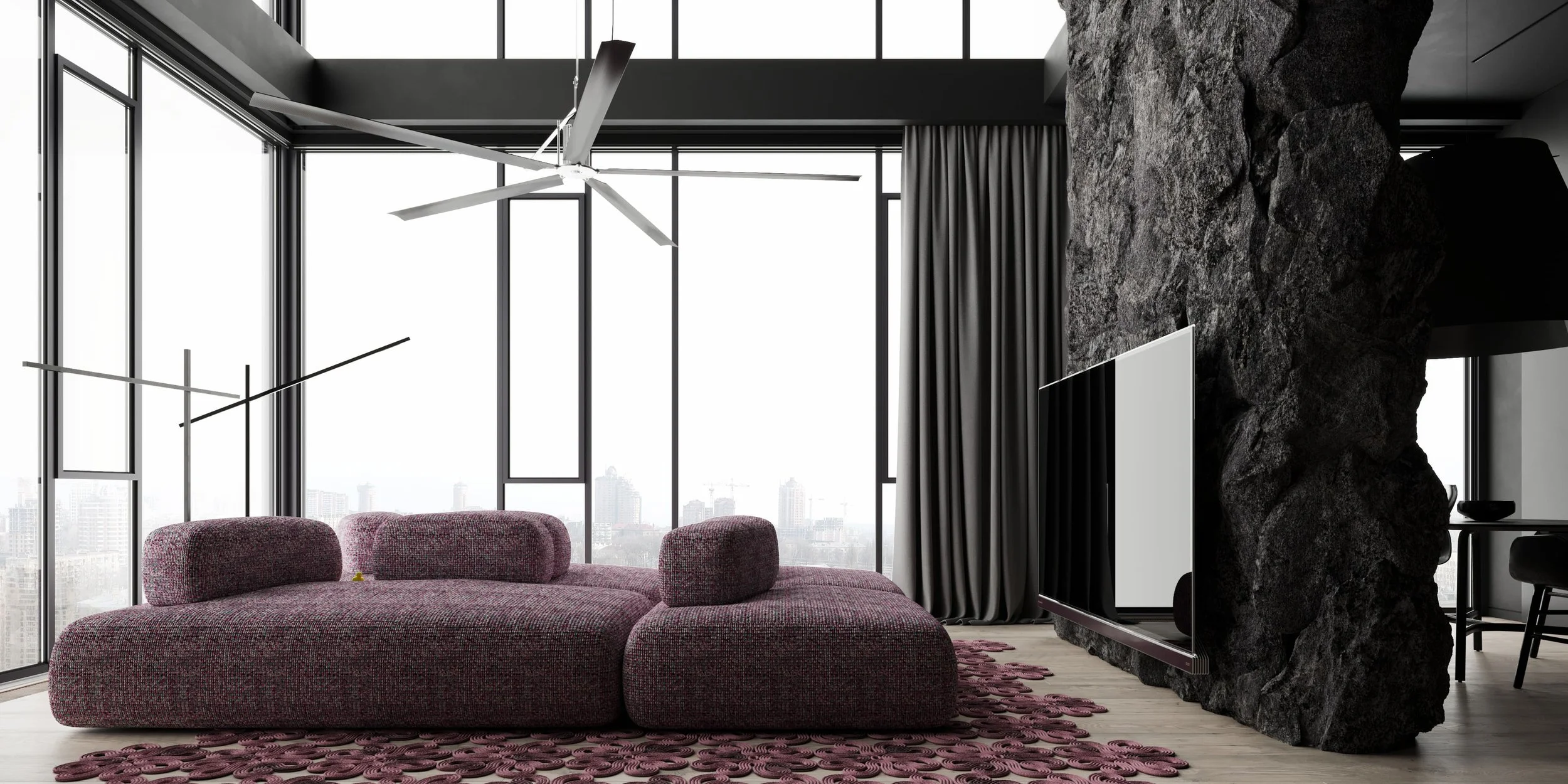
I like natural stone for some of the things people try to eliminate before buying it: irregularity, a complicated pattern, differences between neighboring areas. Stone already has a character of its own. When it becomes a wall, a countertop or a basin, I want to preserve that character in the architecture. I have little interest in refining it until it resembles a flawless sheet of plastic.
That does not mean I think natural stone belongs everywhere. Sometimes one slab is enough for an entire interior. Sometimes the room does not need stone at all. Being natural and expensive does not automatically make a material a good choice. You can buy beautiful marble and end up with a kitchen where it looks strangely accidental. A much quieter stone, given the right place, can produce a room you want to keep looking at.
So the question of which stone is best is too broad for me. First I need to understand where it will be, what someone intends to do with it, and which changes in its surface they are willing to accept. A wall behind a sofa and a countertop used for cooking every day have very different lives.
A stone you want to look at every day
An expressive slab has a particular ability: it can become the main object in a room, even when it is technically just a wall finish. A large vein, a shift in color or an unexpected dark patch can have more presence than many of the objects people subsequently arrange around it.
I would never choose that surface in isolation. Put it beside strongly patterned wood, several metals, another stone and assertive furniture, and every material starts trying to prove something. I find that tiring quite quickly. I would rather give the stone enough space. Let it sit beside a quiet wooden volume, a plain wall, or simply an area left empty. Then there is a chance to see the material itself.
The opposite can be equally interesting. Sometimes I want stone that stays out of the foreground: almost uniform, with subtle transitions that only become apparent up close. It can hold an interior together, revealing its depth through light and touch. I do not see that as a less ambitious choice. Every surface does not have to introduce itself at the entrance.
A small sample can be very persuasive
The sample may show a beautiful gray background and one neat line. On the full slab, that line becomes a large pattern, while half the material turns out to have a different tone. There is nothing wrong with the stone. The problem is the picture we formed of it, if the decision was already made from a small square.
When the pattern matters to a project, I want to see the actual slabs and understand the proposed cutting layout. Where will the sink go? Which portion becomes the island? How will a vein turn onto the side? Sometimes the most interesting part is about to be cut out for the cooktop. That is a rather odd purchase: choosing stone for its pattern and then removing precisely the part that made you choose it.
Bookmatching two slabs can be a powerful move, but I would not use it automatically. Symmetry can make the material feel excessively ceremonial. In a smaller residential interior, a simpler, slightly irregular pattern may be more pleasant than a giant stone emblem across the entire wall. The scale of the room matters, as does the amount of attention we actually want the surface to receive.
Marble, granite, quartzite: the name does not settle the choice
Marble is often chosen for its pattern, the depth of its colors and the way it looks in light from the side. I understand that attraction. But it also has characteristics you need to accept before installation. Marble and other calcium-carbonate stones are sensitive to acids. In a kitchen, these include ordinary ingredients such as lemon juice. The surface can change its sheen, leaving a mark that wiping will not necessarily remove.
Granite or quartzite may be sensible candidates for a different requirement, but I would not turn either name into a promise of invulnerability. The particular slab has its own composition, finish and supplier guidance. Sometimes a commercial name tells you more about the impression a stone makes than about its behavior. I want a clear answer about the selected material, rather than a confident assurance that it will withstand anything.
With limestone, I am especially drawn to a quiet, almost earthy surface. Liking that appearance does not mean it should become any countertop or cover an entire shower. Suitability needs to be checked for the particular application. I might keep a stone I love on a dry wall and choose something else for the working area. That decision does not undermine the overall design.
Matte and polished surfaces create different architecture
I usually feel closer to surfaces that do not continually reflect everything around them. With matte stone, I find it easier to notice the color, pattern and volume, especially beside rough concrete, wood or soft fabric. Light moves through that arrangement in a way I enjoy. I do not need to see a reflection of the window in every plane.
Polished stone can still be beautiful. I might use it as a single deep surface in a dark room, where reflection becomes part of the idea. I would simply look carefully at what it is going to reflect. A view of the garden is one possibility. A row of bright fixtures repeated in every direction is quite another.
A matte finish does not automatically make the material easy to maintain, either. Appearance and resistance are separate questions. I need a sample in the intended finish, one that can be laid horizontally, taken to a window and viewed under the evening lighting. That matters particularly when the same stone will appear on both a wall and a countertop. Those two planes can give very different impressions.
A trace of life, or damage that will bother you
This is a good moment to be honest with yourself. One person enjoys watching an object gradually change. Another wants its appearance to remain as consistent as possible, and every new mark will spoil the experience. There is no point persuading the second person to love patina because their architect finds it beautiful. It is their kitchen. They will look at it every morning.
Staining and acid etching need to be distinguished. A stain involves a substance entering the material, while etching changes the surface through a reaction. An impregnating treatment may improve stain resistance, but it does not make stone impervious or remove marble's sensitivity to acids. An assurance that everything will be coated and therefore problem-free would not settle the matter for me.
I am comfortable with signs of use when I understand their origin and accept the result. That does not mean I intend to call everything that happens to a surface beautiful. A crack in the wrong place, a damaged edge or persistent wetting needs separate attention. A love of natural materials does not excuse poor fabrication or remove the need for appropriate care.
The edge can matter more than another beautiful slab
In interior design, I am interested in how a material becomes a volume. A countertop has thickness, an underside, corners and a relationship with the cabinet fronts. The same stone can appear as a heavy block or an almost slender horizontal line. The detail determines that impression as much as the slab itself.
I like a joint to have a reason for being where it is. It might meet a turn, the boundary of a furniture volume or a change of direction. Pretending joints do not exist can sometimes produce a stranger result than acknowledging them quietly. At the same time, the cutting layout, supports and openings need to be developed with the fabricator. An attractive outline does not explain how the element is constructed.
There is also the question of the hand. An edge someone will touch repeatedly should be assessed through a physical sample. A sharp line can look wonderful in a visualization. In an actual kitchen, I want to know how it feels, how it will be made and whether damage to that particular detail could be repaired neatly.
How much attention do you want to give the material?
I prefer to discuss maintenance calmly and specifically. How should this surface be cleaned? What should be avoided? Does it need treatment, and who could help restore it? There is no single care calendar for all natural stone. It is also better to understand the possibilities for repair before buying, rather than at the moment something unpleasant happens. In a kitchen, that conversation matters as much as choosing a color.
Sometimes it leads someone to abandon a marble countertop while keeping marble elsewhere. I consider that a reasonable outcome of design. We do not have to prove our love of a material by choosing its most demanding application. A texture can stay where it brings pleasure, while a different surface takes on the daily work.
I want natural stone to remain a part of the home that can be touched without anxiety, with its own history, pattern and understood limitations. If protecting a countertop means constantly remembering to behave as though you are a guest in your own kitchen, I would reconsider the choice. A good material should belong to the way you actually live.
