
How to Breathe Life into Desert Architecture
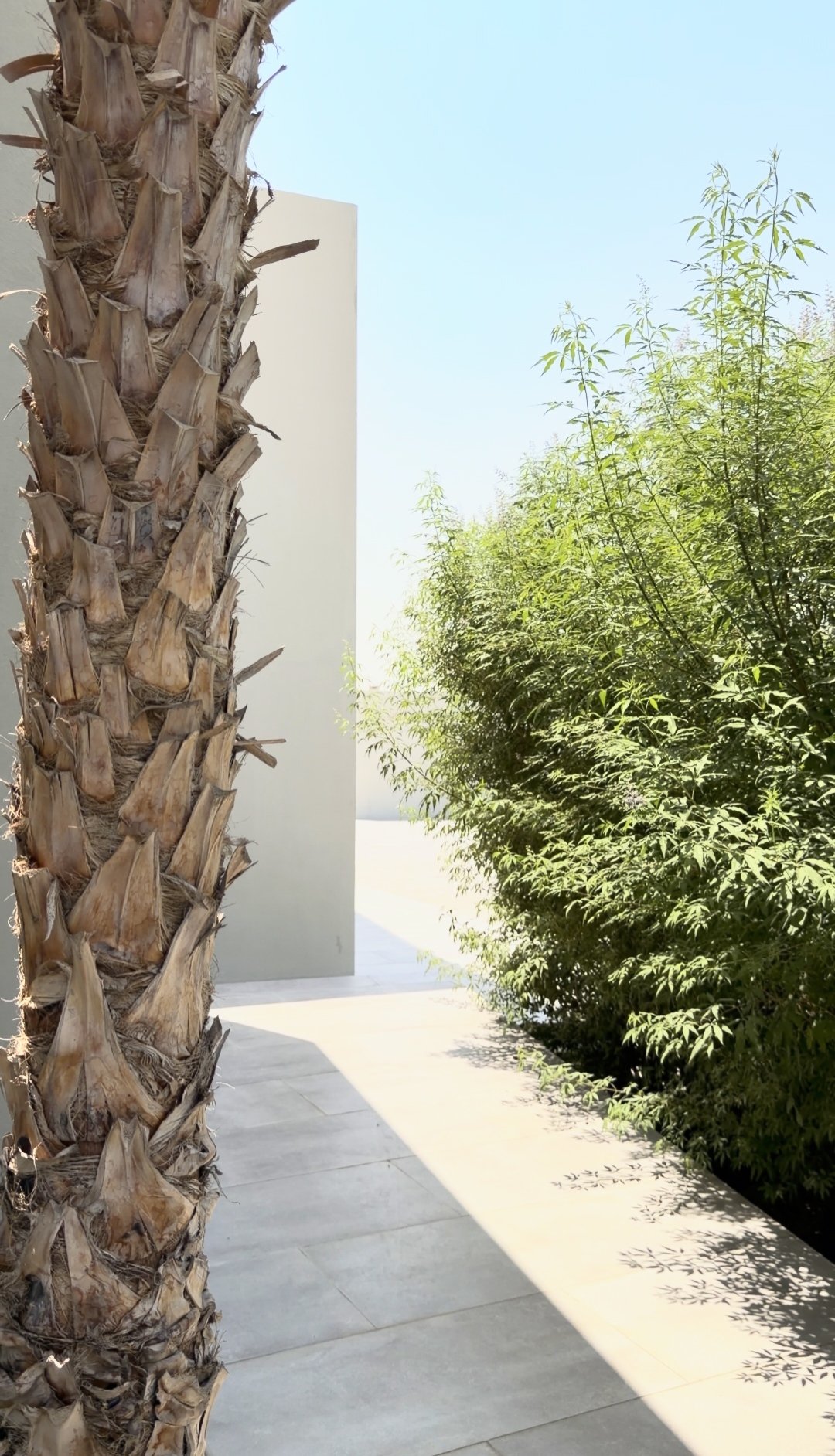
We delivered the complete interior design for the project, encompassing space planning, material and furniture selection, and 3D visualization.
Life can thrive even in the desert. And perhaps it is in the desert that it feels especially profound.
I love integrating greenery into architecture and interior design. To me, plants are not just decor or an attempt to fill an empty corner. They are a living material that can completely transform the perception of a house, a plot, a courtyard, or an interior.
Before working on projects in the UAE—in Dubai, Sharjah, and other cities—I had a rather simplistic view: a desert, a house, sand all around, and that was it. It seemed that architecture here existed almost in isolation from nature.
But the deeper I delved into the local culture, climate, and construction methods, the more I realized how wrong I was. The Emirates are home to many plants that have perfectly adapted to the local environment. With the right selection, proper care, and irrigation systems, they can create a vibrant, beautiful, and profound environment around the home.
Key Insight: The combination of a dry desert, architecture, water, and plants filled with birdsong creates a powerful architectural experience. It is no longer just landscape design. It is an integral part of the architecture itself.
Whether you are building a home from scratch or buying a ready-made villa in Dubai, Sharjah, or any other city in the UAE, I believe it is crucial to think about the garden in advance. Ideally, not just a small patch by the entrance, but the entire plot.
A garden around the house serves several purposes:
Creates natural shade;
Provides a partial shield against desert dust;
Softens the intense heat;
Makes the architecture look visually "alive."
But for me, the most critical aspect is the visual and emotional connection. When you look out the window and see not just a fence, tiles, or sand, but greenery, water, shadows, and reflections, the interior functions differently. The interior shouldn't stop at the glass. When there is a garden outside, the space extends outward, allowing the architecture to breathe.
Plants, Water, and Shade in a Desert Climate
By now, we have designed quite a few villas in Sharjah, and almost all of them are embraced by greenery. Over the years, these solutions have proven themselves beautifully. Of course, this doesn't mean you can plant just anything and expect great results. It is essential to select species that suit the climate, sun exposure, soil, and maintenance requirements.
For this, it is best to collaborate with local landscaping and gardening specialists. They know which plants thrive, how to irrigate them correctly, and how to ensure the garden looks vibrant not just in the first few months, but years down the line.
Water plays an equally powerful role in these projects. Even a small pond, a pool, or a reflecting surface introduces light, movement, and visual coolness. And when plants are nearby, birds begin to arrive.
I love birds. Back on my balcony in Kyiv, I used to feed them often because I enjoy watching them and hearing them sing. I believe it is important for humans to care for the living creatures around them. When birds appear in a garden, the space ceases to be a mere pretty picture. It becomes truly alive.
An Atrium as a Small Oasis Inside the House
If a house is being designed from scratch and there is a willingness to embrace bolder concepts, you can take it a step further and introduce an atrium inside the house.
I am captivated by the idea of an indoor oasis: a small, enclosed or semi-open volume within the architecture that houses water, lush plants, soft light, and a controlled microclimate. Such an atrium can become the heart of the entire home. The layout, movement, views from the rooms, and lighting scenarios can all be oriented around it.
This works incredibly well in hot climates. If the atrium zone is kept relatively compact, its technical aspects—ventilation, humidity, lighting, and irrigation—can be meticulously managed. As a result, a private little world emerges inside the house, living by its own rules.
A Desert House Shouldn't Feel Empty
I don't believe that desert architecture has to be dry, harsh, and empty. On the contrary, this is exactly where finding a balance between climate, materials, water, shade, and living plants matters most.
A modern villa in Dubai or Sharjah can be minimalist, concrete, bright, and strict, yet remain profoundly alive. A garden, a courtyard, water, or an atrium adds depth and brings architecture closer to the human scale.
To me, a great house is more than just walls, a facade, and an interior. It is about everything happening around it: the light, the shadows, the plants, the birds, the reflections, and the air. And even in the desert, you can create a space where you can feel true life.
