
How an Architectural Concept Takes Shape: A New Project for Unreal Engine and the Website
It’s time for my second blog post, and this time, to be honest, I did not even know where to begin. I was not sure what to write about or what this blog should really become.
When something appears as an Instagram Story or a Reel, it feels easy. You have an idea, post it, and move on. But when it comes to writing for a website, it feels completely different. Here, the text is not just text. It has to help people understand what I do, what my studio is about, and how I see architecture, interior design, visualization, and the creative process behind every space.
And that is where it becomes complicated. I am not a copywriter. My mind is built for something else. But I made a decision to write this blog myself — honestly, without auto-generated content and without generic texts that all sound the same. Because if someone is trusting you with their future home, interior, or architectural project, I think they should see more than a polished SEO article. They should see the person behind the work. So this blog will carry only my voice, my thoughts, and my personal view of architecture, interior design, and visualization.
At some point, I realized it made more sense to write not about something abstract, but about what is happening with me right now. At the moment, I am thinking about a new project for the Unreal Engine section of my website. That section is still waiting to be filled. I only recently reached a point where I feel my Unreal Engine work is strong enough to show publicly, and now it is becoming a direction I want to develop more seriously.
Because of the war, there are naturally fewer clients than I would like. So I decided that from time to time I will create personal concept projects — without compromises, without revisions, and without trying to satisfy everyone. Just projects that reflect how I personally see ideal architecture, a modern house, and the kind of atmosphere I want my studio to express. For me, these are not just beautiful renders. They are a way to show my own approach to architecture and interior design while also developing the way I present projects through Unreal Engine.
I do not want these works to be just visualizations. I want to gradually integrate more tools into them: material variations, lighting changes, different environments, different moods of the same space, and other options that make architectural visualization feel more alive and engaging.
In a way, this lets me do two things at once: create new concept work for my website and portfolio, while also expanding the Unreal Engine side of my design process.
This time, everything began with the landscape. And landscape is an important subject for me. In the future, I want to focus more and more on architecture, and landscape design is not a secondary layer — it is a fundamental part of how a house is experienced. A strong architectural project cannot exist separately from nature, topography, air, light, and the emotional feeling of being inside that place.
Once I created the landscape, I almost immediately understood what kind of house belonged there. It is not about status, not about showing off, and not about trying to impress. It is more like a completely open retreat — a house for silence, air, and peace. A place where you arrive and stop thinking about noise, neighbors, or who might be looking into your windows. Instead, you open the house from every side, let nature come inside, feel the wind carrying the scent of wildflowers, and watch the clouds move over the mountains and disappear somewhere beyond the horizon.
That feeling is what this entire project is now built around. I am slowly filling the scene, layer by layer, adding details, mood, and character. But I did not want it to become just another dry interior or just another architectural render. I wanted it to include things that catch attention, create emotion, and say something more about the person who might live in such a space.
That is why I added a padel court outside. Padel is one of the fastest-growing sports right now, and it felt like a very precise addition for this kind of house. It brings energy, rhythm, and a sense of contemporary life. It makes the place feel inhabited rather than staged.
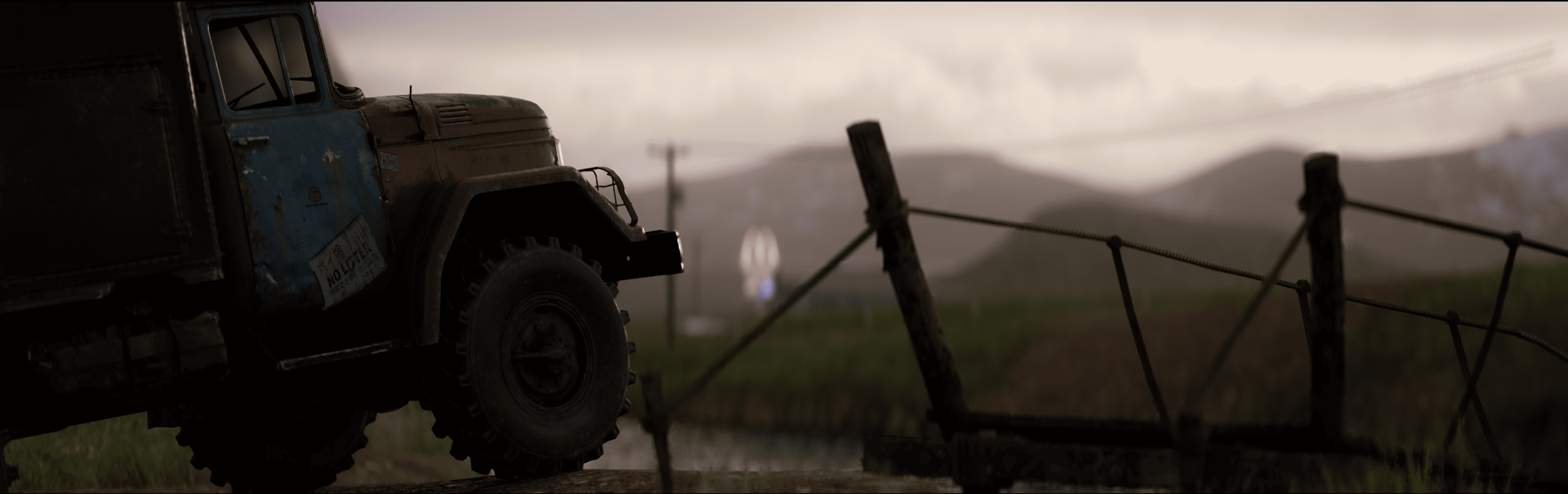
Then I decided to add a piece of myself to the concept. I placed my favorite truck there — the ZIL 133. I liked the idea that if this is my ideal house in my ideal place, then there should also be room for my own interests and personal references. Details like that make an architectural concept feel more honest. They remove the sterile quality and turn visualization into a story.
Then I caught myself thinking about something else. Yes, nature is beautiful. Silence is beautiful. But sometimes you still want some distant sign of civilization. Not right next to you, not too close, but somewhere far away, almost as a reminder that the outside world still exists. So I decided to add one detail that is almost absurd, but somehow very alive — a McDonald’s sign in the far background. I like that contrast: nearly perfect natural silence, an open modern house, mountains, wind, wildflowers — and somewhere in the distance, a small symbol of civilization still glowing on the horizon.
That is where this project stands right now. It is still in progress. I am continuing to build it, shape it, and fill it with more meaning. But even at this stage, I already like not only how it looks, but what it feels like. For me, this is not just another render. It is an attempt to build a space where architecture, landscape, atmosphere, personal story, and the new possibilities of Unreal Engine all come together.
This project will be called #MMZ4H. I will be sharing it on Instagram, adding it to my website, Behance, and other platforms. So this is only the beginning.
