
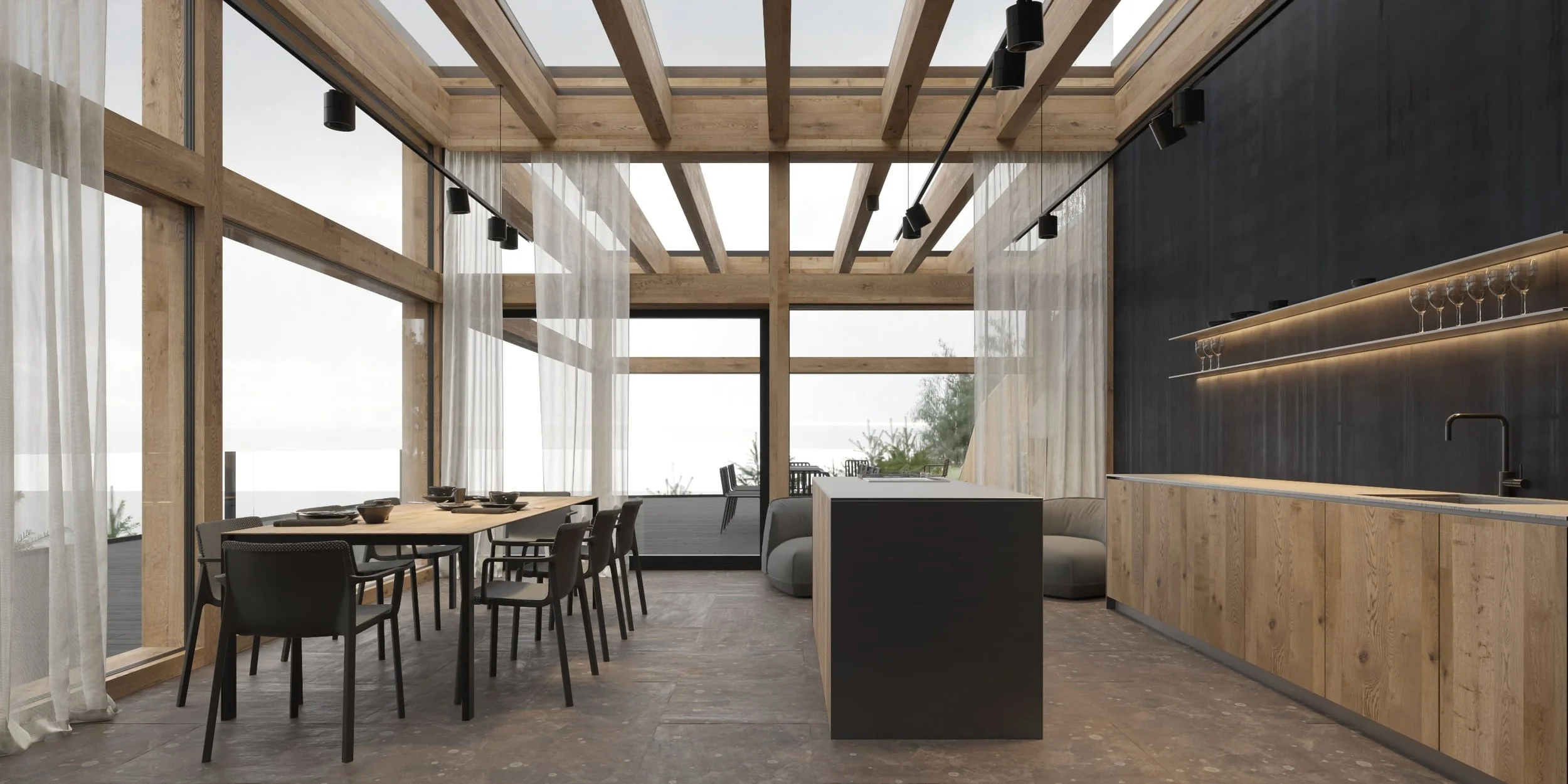
In regions defined by intense sunlight and extreme summer temperatures—particularly in Dubai, Abu Dhabi, and across the UAE—a luxury villa’s true living area is rarely defined by its interior walls alone. When designing contemporary residences in the Emirates, the transition between the cool, sheltered interior and the bright exterior is one of the most critical architectural challenges. If handled poorly, the terrace becomes a purely visual buffer zone—pleasant to look at through floor-to-ceiling glazing, yet uninhabitable for half the year.
At Sirotov Architects, we approach luxury villa architecture in the UAE by treating exterior spaces not as add-ons, but as seamless extensions of the interior volume. Achieving a calm, minimalist aesthetic while ensuring year-round thermal comfort in the Middle East requires integrating climate control directly into the architectural geometry.
Dissolving the Boundary in Contemporary UAE Residences Minimalist architecture relies on clean sightlines, uninterrupted floor planes, and a restrained material palette. Whether a private residence is located on Palm Jumeirah in Dubai or Saadiyat Island in Abu Dhabi, sliding away the glass facade should allow the living room and the terrace to read as a single, continuous space. This illusion breaks immediately if outdoor shading is treated as an afterthought. Retrofitted canopies, bulky support columns, and exposed wiring disrupt the visual quietness of a modern facade.
To preserve architectural purity—and streamline community design approvals across UAE master developments—the transition zone must be resolved at the earliest stages of spatial planning. Ceiling heights, structural spans, and drainage channels are aligned so that the exterior ceiling plane continues the interior rhythm without visual clutter.
Controlling Light and Microclimate in the Emirates A functional outdoor living space in the UAE’s desert and coastal climate requires dynamic control over solar radiation and airflow. A permanent, solid concrete overhang provides deep shade, yet it often deprives the adjacent interior rooms of natural daylight and traps rising heat during still Dubai and Abu Dhabi evenings.
To solve this, modern residential architecture across the UAE increasingly relies on adaptive shading systems. Integrating architectural bioclimatic structures—such as the motorised louvred systems by Sky Pergola—allows the building envelope to respond to the sun’s path throughout the day. Adjustable aluminium blades can be angled to block harsh midday UAE sunlight while maintaining natural cross-ventilation, or opened completely at night to release accumulated heat and reveal the sky. Because these systems are engineered with clean, geometric profiles, they align naturally with minimalist concrete, stone, and glass facades.
Proportion, Shadow, and Materiality for the Gulf Climate In the bright, sun-drenched environment of the Emirates, shadow is a primary building material. Deep recesses and louvered overhangs create shifting patterns of light and dark across stone floors and plaster walls, giving a minimalist villa facade depth and tactility.
When specifying materials for outdoor architecture in Dubai and Abu Dhabi, durability against heat, humidity, and sand is inseparable from aesthetics. Natural timber brings warmth, yet under extreme UV exposure and arid winds, it demands relentless maintenance to avoid warping or fading. Powder-coated architectural aluminium and natural stone maintain their crisp edges and muted tones over time, ensuring the residence ages gracefully without losing its sharp, monolithic character.
Engineering the Invisible True minimalism demands rigorous technical coordination behind the scenes. Concealed gutters within structural columns, recessed linear lighting, hidden electrical conduits, and integrated misting or outdoor cooling systems must all be mapped out before construction begins. When engineering is buried within the structure, all that remains visible to the resident is pure form, filtered light, and effortless comfort.
Designing luxury villas in Dubai, Abu Dhabi, and across the UAE is ultimately about respecting the local climate rather than fighting it. When shade, airflow, and structural proportions work together from the very first sketch, the terrace ceases to be an exterior feature—it becomes the most lived-in room of the house.
