
Vegetation: The Foundation of Architecture in Bali
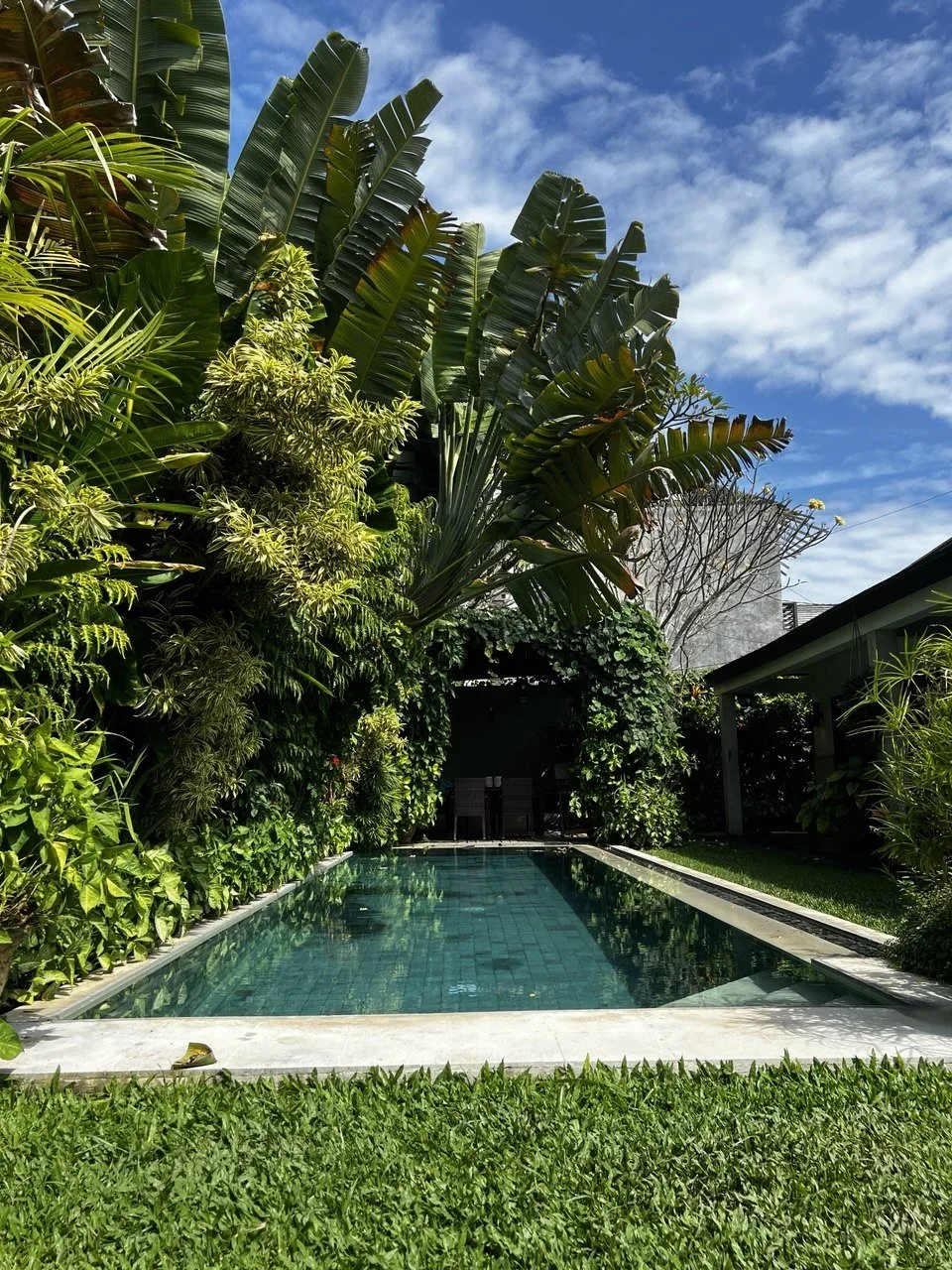
The older I get, the more I find myself thinking that a house is simply better than an apartment.
Throughout my life, I’ve designed many apartments and many houses. Before, it seemed to me that an apartment was a more convenient, universal, and straightforward format. It requires less involvement. Less maintenance. Less constant attention. In a sense, an apartment is simpler: you lock the door, and that’s it. But at some point, you begin to feel that an apartment, no matter how spacious, is always a confined box where your boundaries end exactly where your neighbor's concrete begins.
With time, you start to want something else.
More space. More silence. More air around you. You want to have not just walls, furniture, and a beautiful view, but a territory of your own. A place where you can plant something, watch it grow, do something with your own hands. Even if not everything succeeds. Even if some plants die, some don't take root, and some behave entirely differently than you expected. There is a kind of meditation in this process — you finally stop just consuming space and start creating it. There is still something profoundly alive in that.
And for that, you need land.
Sometimes I think about where the best place is to have a holiday home. Not a primary residence, not a place where you have to be every day, but a small sanctuary of your own where you can arrive and immediately feel that you’ve finally exhaled.
I think islands like Bali or neighboring Indonesian regions are perfect for this. There, a house can be relatively simple to maintain. Not because it requires no care at all, but because the climate itself works in tandem with the architecture. There, walls often become a formality, and the boundary between "inside" and "outside" practically disappears. You don’t have to convince plants to live there. They need light, water, and a bit of attention — and they begin to thrive on their own, becoming part of the interior.
You can design a house so that a garden bed is literally in the middle of the space. Not as a decorative element that needs constant saving, but as a genuine part of the house. A living fragment of architecture. You realize that it doesn't need much, yet it will gradually fill the space, change it, and make it softer and more honest.
In Kyiv, plants don’t grow the way they do in the tropics. They must be protected, brought indoors, seasonal cycles must be planned; you fight against the cold, dryness, heating, and lack of light. In our climate, nature is a guest that you have to try very hard to keep. But in the tropics, nature is not separate from the house. It immediately becomes part of life.
One of my most vivid memories of Bali is from a business trip. We were renting a villa during a project. This villa had a small private pool, and directly above it hung lush greenery. Palm leaves and other plants literally dangled over the water.
And when you swim, you don’t have a ceiling above your head, or a concrete slab, or a perfectly painted surface. You have leaves above your head. In moments like these, you realize that true luxury is not the expensive finish of a pool, but the opportunity to feel like part of the forest while being at home.
It’s a very simple sensation, but for some reason, it stuck with me. Since then, I’ve returned to this idea many times in my projects. I like it when architecture doesn't just stand next to nature but lets it inside. When a plant is not just a pot in the corner, but a full participant in the space.
Currently, we are working on several projects in Dubai, and there, this theme feels entirely different. You can green Dubai, of course. But it requires far more resources, engineering, water, care, and money. In Dubai, greenery is a struggle for survival and a constant operation of life-support systems. In a tropical region, greenery works naturally.
And perhaps that is why it seems to me more and more that the ideal holiday home is not just beautiful architecture in a beautiful place. It is a house where the climate, plants, water, shade, and air become part of the project from the very beginning.
Not as decor added after construction. But as the very reason you wanted to build the house in the first place.
