
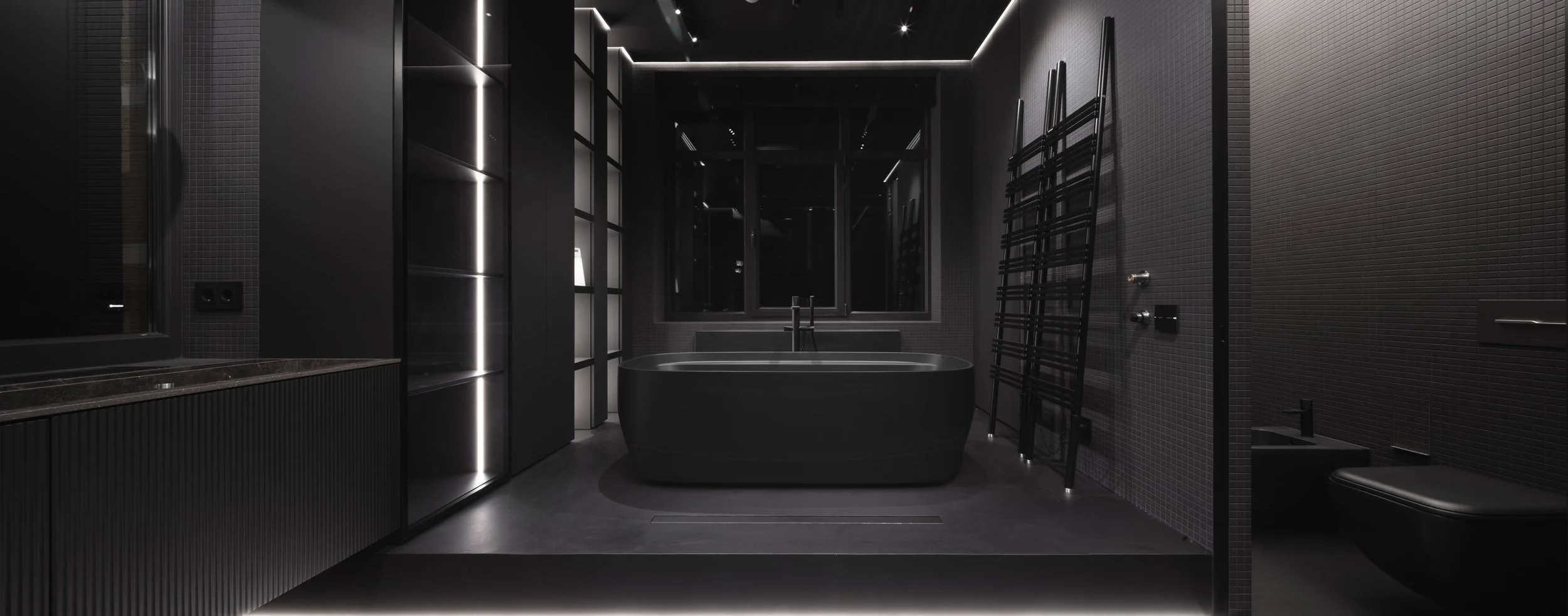
I like dark bathrooms. I enjoy a light source that remains out of view while the edge of a stone is illuminated, a small reflection appears on the water, and part of the room stays in half-light. Distance, texture and the objects themselves feel different to me in that setting. A basin becomes a volume, a wall gains depth, and there is no need to examine every item in the room at once.
I also understand perfectly well that a bathroom is a place to shave, look in a mirror, find a particular bottle and occasionally clean. Keeping it permanently in beautiful darkness seems just as strange to me. A good dark interior should be able to change with what someone is doing. Otherwise it becomes an impressive image that is rather awkward to live with.
A dark bathroom does not have to be black
My intention is not to paint everything one color. Dark stone might be gray, brown or almost mossy in tone. Wood can introduce deep earthy shades. A mineral surface may have variations that become visible only under particular light. Those differences interest me more than a collection of equally black objects.
When walls, floors, furniture and fixtures share one flat tone, their volumes can disappear. Boundaries become difficult to read and a material turns into a patch of color. That might be exactly what I want in one area. I would not make it compulsory throughout the room, though. Somewhere there needs to be an edge, a reflection, a difference in finish or a lighter plane.
A heavy dark basin, for example, can read clearly against a quieter background. Alternatively, a pale bowl might become the only prominent object within a deep surrounding space. I like deciding what someone will notice first and what they will discover as they move closer. Even a small bathroom can then unfold in a sequence.
Where the light arrives matters
I do not start a room like this with an evenly spaced grid of ceiling lights. First I imagine the surfaces I want to see in the evening: one edge of the basin, the lower part of a wall, a recess, a reflection on glass. Illuminate everything equally and the dark material may contribute little beyond its color. The atmosphere came from the relationship between what was visible and what remained hidden, and we have just removed it.
Sometimes a fixture interests me precisely because it is almost absent from the view. Light emerges from a recess and touches a surface while the equipment stays secondary. Concealing the source is not enough, however. It needs to be assessed from actual positions: inside the shower, at the door, sitting in the bath. A detail that looks elegant in an elevation might otherwise become a bright strip directly in front of someone's eyes.
The mirror is a separate conversation. I want to see my face properly there, rather than demonstrate loyalty to half-light. Mirror lighting should be considered with its position, reflections and the way someone approaches the basin. One dramatic fixture overhead does not have to solve every requirement. The surrounding atmosphere can be preserved while clearer lighting is provided where it is needed.
Cleaning also deserves its own setting. I have no objection to switching on enough light to see the surfaces and put the room in order. That does not destroy the concept. The light can be switched off afterward.
That is all.
I am more concerned by controls that require someone to take out a phone and remember the name of a scene for every action. I like technology, but the basic settings should remain understandable. Quiet evening light, mirror light and general illumination can be arranged so they are used naturally, without turning every bathroom visit into an equipment setup session.
Dark materials beside water
Finish and reflection become particularly important on a dark surface. Polished stone can have a deep luster, but it also introduces reflections of fixtures and surrounding objects. A matte surface behaves differently. I usually prefer matte surfaces, but I do not consider that a universal answer. Some materials are interesting precisely because of the depth of their reflection.
I therefore look at a real sample under the light I intend to use. I also want to understand how the surface looks wet, how it dries and what will be used to clean it. Those are ordinary questions for a bathroom. It would be strange to choose a material from an attractive dry sample and then be surprised that it spends much of its life beside water.
Black bathroom fittings, dark stone and painted elements do not all behave alike. Water marks on a particular finish may be more noticeable than expected. I want to see a sample, understand the manufacturer's limitations and know how the owner feels about daily maintenance. If every mark is irritating, sending someone to live in that interior with the consolation that it looks beautiful is hardly a good solution.
With natural stone, it is especially important not to confuse an appealing appearance with a suitable application. Marble and other acid-sensitive materials need appropriate care. Wood or wooden furniture near water also requires construction and finishes suited to the selected position. I like dark stone beside wood, but wanting the combination does not remove the conditions of the room.
Water makes the detail very specific
Visually, I am drawn to a coherent shower area: a few large planes, a clear opening and very few arbitrary projections. That simplicity emerges after some ordinary questions have been answered. Where does the water drain? Where can it remain? How are the connections made? Can the necessary components be reached for servicing? Without answers, the smooth image means very little.
Tile or stone cladding does not itself replace a waterproofing system. The substrate, drain, junctions and concealed layers need to be coordinated. I want those matters resolved with the relevant specialists before the surface layout is finalized, especially when the idea depends on visual continuity and a few important, precise lines.
I also do not want to add complexity for the sake of an impressive name. A large shower, several heads, a waterfall and further functions make sense if the person actually wants to use them. A much simpler place can still be enjoyable. Sometimes one satisfying flow of water and well-positioned light are more interesting than a whole collection of possibilities that are rarely switched on.
A bathtub is not compulsory, either. If it is loved, it deserves a considered position and a view. If it is not, I would rather give the space to a comfortable shower or a clear passage. A bathroom does not become complete only after everything available in a catalog has been fitted into it.
Daylight can remain part of a dark room
A dark bathroom does not require the absence of a window. I enjoy the contrast between deep surfaces and a living view outside. It might be a small sheltered courtyard, a plant or a piece of wall across which sunlight moves. In that relationship, the material changes through the day and the room gains a sense of time.
Privacy needs to be considered for actual use, including the evening. Beautiful glass in a visualization does not explain what will be visible from outside when the lights are on. I would consider the window's position, the protection of the view and a curtain or another means of closing it with the layout. Those elements should also be manageable when someone's hands are wet.
Without a window, I would not automatically imitate daylight across the entire ceiling. The more enclosed character of the room can be accepted and developed. The person still needs appropriate lighting and a clear understanding of the space. An intimate bathroom has an attraction of its own; it does not have to impersonate another kind of room.
Belongings and maintenance will remain
In interior projects, a bathroom can appear very composed, but I want that condition to be linked to convenience. Toothbrushes, cosmetics, towels and a hair dryer need real places. Some objects can be enclosed, while others stay within reach. The owner should not have to hide everything repeatedly merely to preserve the architectural idea.
In a dark room, I pay particular attention to the inside of an open cabinet or recess. The interior continues when a door opens. Someone should be able to see and retrieve its contents without searching inside another dark box. Shelf size, opening direction and, where appropriate, internal lighting have tangible value.
I feel the same about repair access. Equipment that will need servicing must remain reachable behind the finished surface. A concealed detail is successful while it stays available for its purpose. Covering everything in beautiful stone and hoping it will never need to be revisited is a weak foundation for peace of mind.
Where I would introduce something lighter
I am not going to defend a dark palette at any cost. A lighter surface may make one part of the space clearer; a pale area beside the mirror may feel more pleasant. In another room I might choose softer grays and earthy shades instead of deep black. The intention is to retain the desired feeling, rather than fulfill a formal promise to make everything dark.
I want a room that can almost disappear around water and a few illuminated details in the evening, then return easily to ordinary tasks in the morning. That ability to change its state is what attracts me to a dark bathroom. There is depth and quiet, but the person remains central, with their habits, belongings and the right to turn on more light.
Why I Like Dark Bathrooms, and How to Make Them Work

Next
Next