
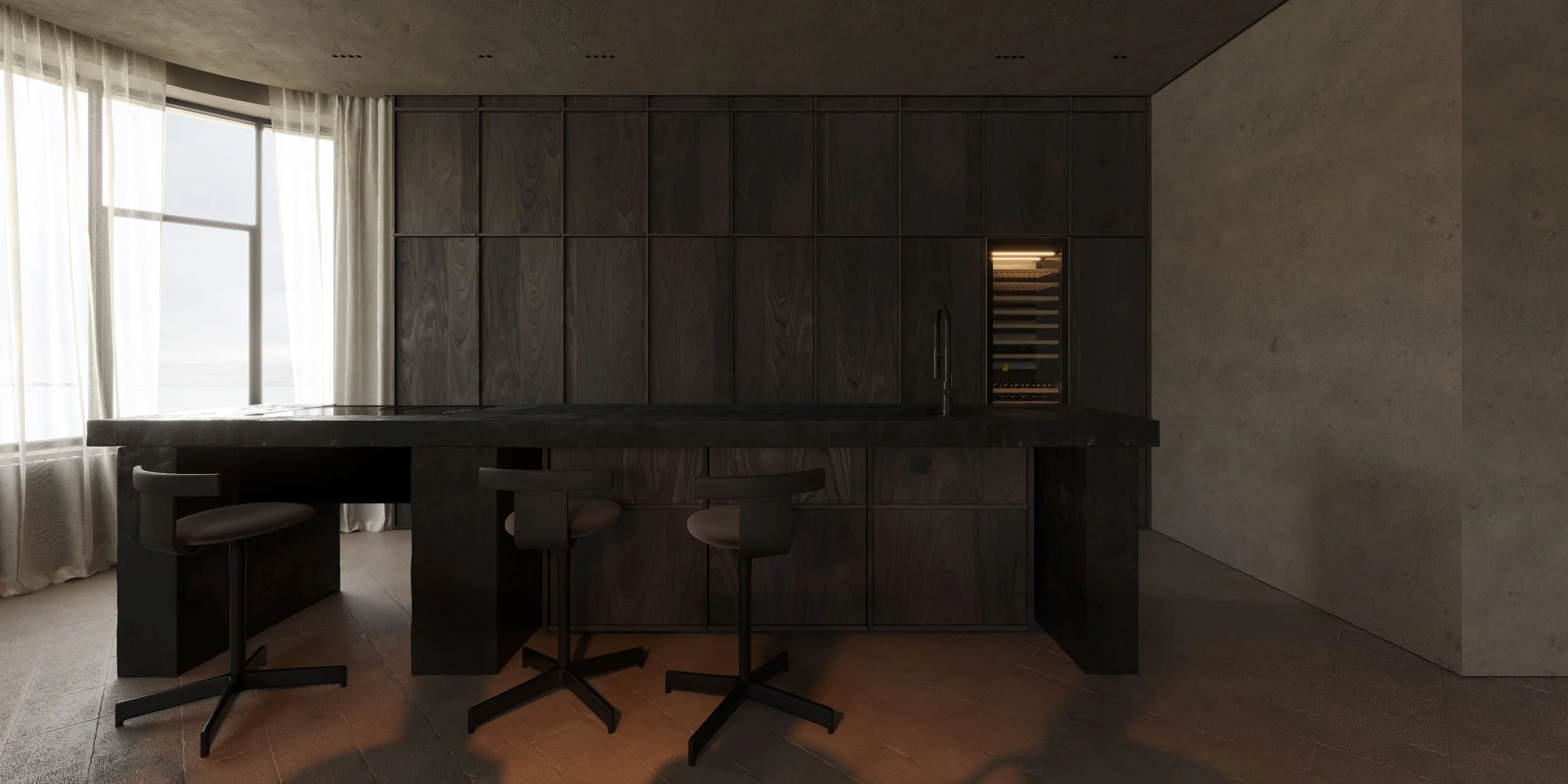
Sometimes people try to make a concrete interior feel livable by following a simple formula: add wood. A little on the ceiling, some on a wall, slats beside the television, another panel somewhere else. The assumption is that the space will automatically become warm. To me, the material is being asked to do work the design should already have done.
I love concrete and wood together. But I am interested in why they sit beside one another and what each does to the space. Wood can be unnecessary, even when it is beautiful. A concrete room can be a pleasant place to live with very few wooden elements. It depends on proportion, light, furniture and how someone feels inside that geometry.
The brutalism I feel close to can accommodate ordinary life. You can sit down, stretch your legs, put something on the table without feeling you have disturbed the author's installation. Strong architecture should be able to withstand that. If the idea collapses when someone uses the room, I would question how well it was conceived in the first place.
Where I want weight
I like the sense of mass in concrete. Sometimes I want a wall to read unmistakably as a wall, with depth around an opening, a substantial edge and a shadow near the floor. One such element can give a room more coherence than several decorative devices. It establishes a clear foundation against which furniture and people can take their places.
Mass needs room, though. Wrap a small space in equally assertive texture on every side and the distinction between the main element and its background can disappear. Everything becomes equally insistent. I would rather choose one important plane and let the others behave more quietly. Concrete retains its presence, while the room still has somewhere to go.
The same applies to furniture. A heavy stone or concrete table does not require equally heavy chairs, a massive cabinet and an enormous light fixture. I am more interested in difference. A thin wooden line, a low upholstered chair or a clear area of floor can sit beside a powerful volume. Empty space contributes to proportion, even if it somehow never appears in the material specification.
Exposed concrete and a concrete finish
If suitable concrete exists in a building, I am interested in what can be done with it. Formwork marks, variations in tone and small irregularities sometimes offer exactly the depth that people later try to reproduce decoratively. Leaving a structure exposed, however, requires an assessment of its condition and suitability for the interior. Liking a style does not turn every discovered concrete surface into a finished wall.
I am also comfortable with decorative finishes when their purpose is clear. An existing apartment may offer no practical way to create the intended plane in cast concrete. That does not mean the entire idea must be abandoned. An appropriate finish can be chosen and developed through its actual characteristics, samples and application process.
What I dislike is asking a material to impersonate everything at once. Arbitrary seams and tie holes, for instance, drawn without any relationship to the wall's dimensions, furniture or openings. Texture becomes a costume. I would prefer a simpler surface that belongs to the room's architecture over a convincing imitation of some unrelated building.
Wood does not have to fill everything else
If concrete establishes the larger structure, wood can operate more precisely. It might form one substantial furniture volume, a table, the inside of a recess or a handrail. I like its position to make sense. Someone should be able to understand why the material changes at that point and how the change relates to using the space.
A large quantity of slats does not persuade me on its own. Sometimes they have a clear purpose: filtering a view, creating a boundary, producing a particular pattern of light. But when they simply cover a wall because it seemed empty, the result quickly feels familiar. I would first ask whether that wall should remain free.
Wood already has its own pattern. Adding another closely repeated rhythm on top can be unnecessary, particularly in a room that already contains many lines: cabinet divisions, windows, doors, curtains and floor joints. Sometimes a quiet wooden plane gives me all the depth I want, without further exercises in decoration.
Grain and the size of the element
The same veneer looks different on a small door and across a long wall. At a larger scale, its direction, repetition and transitions between components become apparent. That makes it difficult for me to choose wooden furniture from a small sample alone. I need to understand the pattern of the entire surface, sometimes through a full-size section of the proposed piece.
Horizontal grain can support a long low volume, while vertical grain can connect tall cabinet fronts. Neither is a rule to follow in every room. I look at the directions already present in the architecture, where I want a line to continue and where I want it to stop. Sometimes one wooden object should have an independent character instead of being absorbed into a single pattern.
I do not need every timber surface in a house to share the same color, either. A table can differ from the cabinets. An individual chair may have a history of its own. The differences need to make sense. When every item is commissioned in an attempt to match one exact shade, the room can end up resembling a furniture showroom set, only considerably more expensive.
I also look at the colors side by side. Gray concrete can feel almost beige, or move in a cooler direction. Nearby wood can support that impression or argue with it. I do not want to choose a sample simply because it has an attractive brown color. Put the materials together and one may suddenly look orange, muddy or excessively contrasting. A small change in finish can sometimes achieve more than replacing the entire palette.
Solid wood and veneer without a contest in authenticity
Solid timber interests me, especially where I want to see and feel the thickness of the wood itself. But I do not consider veneer a compromise by definition. It may be appropriate for a large furniture volume. The choice depends on the construction, surface, edges and the result we actually want to achieve.
For me, saying that something is natural wood does not settle the question. What is inside the element? How is the edge made? Where does the joint arrive? How will the door open? A beautiful face can have a poorly considered continuation. Conversely, a restrained piece can become convincing through details that are barely noticed at first.
Wood changes dimension as its moisture content changes. Fixings and connections therefore need to suit the specific material and construction. I would not ask a fabricator to reproduce a beautiful line literally if it does not work technically. Equally, a technical explanation should not automatically destroy the idea. The task is to find a detail in which the two can agree.
The places a hand reaches
In residential interiors, I am particularly interested in the scale of touch. From a distance we see the overall volume. Moving closer, we notice an edge, a recess, a handle. Sitting down, we feel the tabletop beneath a forearm. At that point the material becomes very specific, and one beautiful photograph can no longer explain the experience.
I would spend time on a sample of an edge that will be used every day: its smoothness, its shape, the way a hand enters the grip. These are small things, but they recur constantly in daily life. A wooden element may take up very little space and still define how someone feels about a much larger concrete room.
The same applies to junctions. I like a clear transition that allows each material to retain its character. Sometimes a shadow gap is appropriate; elsewhere it may be a carefully drawn trim, or simply moving an object away from the wall. Not every junction needs to be seamless. Trying to conceal absolutely everything often makes a solution more complicated and less honest.
Light and fabric are part of the conversation
The phrase concrete and wood tells us very little about how a room will feel in the evening. The same interior can look flat under bright, uniform lighting and become deeply three-dimensional when some surfaces are left in shadow. I enjoy light that reveals particular parts of a material instead of trying to display every pore at once.
Upholstery and textiles introduce another scale. They should not arrive as an apology for the concrete. A chair, rug or curtain has its own role in the room. If the space is reverberant, that also needs separate consideration: the quantity of wood alone does not guarantee suitable acoustics. Sound depends on the space and the particular surfaces within it.
I want an interior like this to become someone's own over time. Wood may acquire marks of use, light will fall differently across the concrete, and an object the owner truly loves may find a place nearby. Residential brutalism, as I see it, can withstand those changes. It has a strong enough foundation for life to continue around it.
